

9 min readAuthor: MojeInBodyUpdated

Creatine and Water Retention in Women: What Does InBody Data Actually Show?

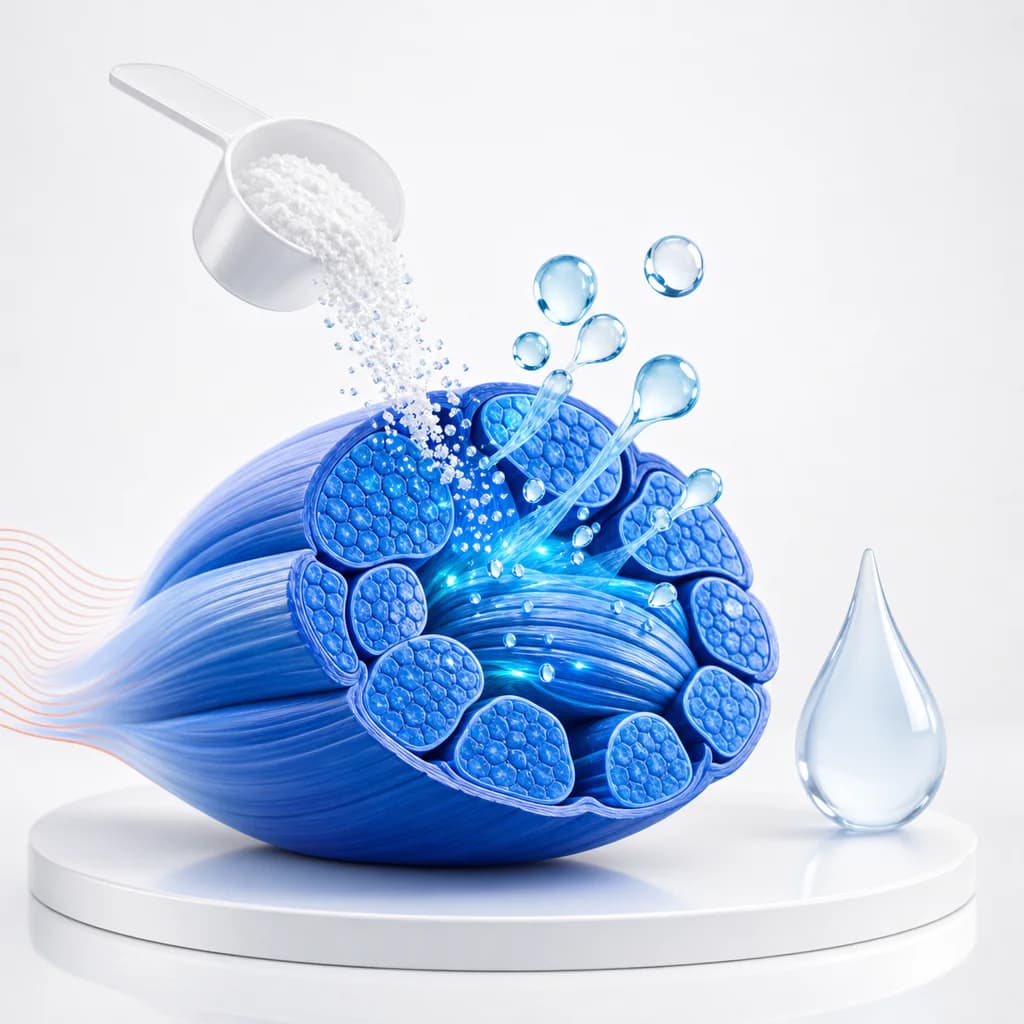
Creatine can increase body water and scale weight, especially in the first days of loading, but studies do not agree on the size of the change or show that it occurs only inside cells. In a randomized acute study in women, both intracellular and extracellular fluid changed depending on menstrual-cycle phase. InBody can track estimated TBW, ICW and ECW over time, but one visit cannot prove that creatine caused a change or rule out clinical swelling.

Creatine and Water Retention in Women: What Does InBody Data Actually Show?

Does Creatine Make Women Retain Water? The Short Answer

The short answer is yes, creatine can retain more water, especially during an initial loading phase, but responses vary between people and studies. Creatine is osmotically active and stored mainly in muscle, so an intracellular increase is physiologically plausible. Research has also found higher extracellular water or no meaningful long-term change.

A small weight increase after starting creatine should not automatically be called fat or oedema. Conversely, visible swelling cannot safely be dismissed as “just water in muscle.” Shortness of breath, one-sided swelling or rapid unexplained weight gain needs medical assessment.

Female-specific evidence is smaller than the overall creatine literature. It is more accurate to describe a possible, usually modest water shift than to promise one predictable response.

What's Actually Happening to Body Water — Intracellular vs. Extracellular

Total body water (TBW) splits into two main compartments: intracellular water (ICW), held inside cells, and extracellular water (ECW), which circulates between cells, in blood plasma, and through tissue. This distinction matters because the two compartments mean different things physiologically — ICW typically tracks with muscle tissue volume and hydration, while a disproportionately high ECW share is more often linked to swelling, inflammation, or fluid-balance issues.

A research review describes short studies with increases in TBW, ICW and ECW, and longer studies with no significant change. A randomized study of 30 active women after five days of loading found increases in total, intracellular and extracellular fluid in the luteal phase. These data do not support a rule that creatine adds only ICW.

Muscles may look fuller, but appearance cannot identify fluid compartments. InBody and other BIA methods estimate them from electrical properties; they do not measure the cause of a change or replace clinical assessment of swelling.

What InBody Shows: The ECW/TBW Ratio

InBody 970 measures body water segmentally — separately for the trunk, arms, and legs — and breaks it down into total water (TBW), intracellular water (ICW), and extracellular water (ECW). From these numbers it calculates the ECW/TBW ratio, which shows how much of your total water sits in the extracellular compartment. In a healthy, well-hydrated person that ratio stays within a stable, narrow range as a general guide; a rising ratio is one of the signals worth a closer look when tracking body composition.

A stable ECW/TBW ratio while TBW changes can be compatible with an intracellular shift, but it does not prove it or identify the cause. The ratio can remain similar when both compartments change. A marked or repeated rise is context for caution, not a diagnosis.

One before-and-after test cannot separate creatine from menstrual phase, hydration, carbohydrate and salt intake, training or estimation error. Comparable repeat measurements and symptoms provide better context.

Loading vs. Maintenance Dose — Why the First Week Can Feel Different

A loading phase means a higher starting dose of creatine — commonly cited as around 20 g per day, split across several doses, for 5 to 7 days — meant to saturate your muscles with creatine faster. Skip it, and you reach the same saturation gradually, typically over three to four weeks on a maintenance dose of 3 to 5 g per day. The choice between the two is about how fast you want the effect to kick in, not a requirement for creatine to work at all.

Loading saturates muscle stores faster, and early water or weight gain is reported most often in the first days. Without loading, saturation develops more gradually. A specific ECW/TBW change cannot be promised: studies use different protocols, and the acute randomized study in women found changes in several fluid compartments without a significant body-weight difference.

What happens to body water by dosing type
AreaTypical effect on TBWTypical effect on ECW/TBWHow fast it shows upWhat it means for feeling "bloated"
No creatine (baseline)Stable, shifts only with cycle, training, and fluid/salt intakeStable, within the usual range as a general guide—No creatine-specific effect
Maintenance dose, 3–5 g/dayMay change gradually; an increase is not certainCannot be predicted reliably; follow the trendGradual, roughly 3–4 weeks to full saturationIndividual; a water estimate alone does not explain the sensation
Loading phase, ~20 g/day for 5–7 daysAn increase may appear sooner than without loadingEvidence varies; both ICW and ECW may changeFast, within the first weekSome notice weight change or digestive discomfort; neither is the same as swelling

Creatine or Your Cycle? Telling Two Different Influences Apart

Feelings of fluid retention or bloating can vary across the menstrual cycle without creatine. Studies do not, however, show the same rise in total body water in one particular phase for every woman; effects on BIA estimates are often small or variable. If you start creatine at the same time, neither a symptom nor one measurement can reliably separate the two influences.

Without a repeat measurement taken at a comparable point in your cycle — or at least tracking the trend across several cycles — a single reading can't reliably tell you whether a change came from creatine, your cycle, training intensity, or just a different salt and carb intake that day. That multiple-cause problem is exactly why it doesn't make sense to react to one isolated number.

The practical takeaway: measure at roughly the same point in your cycle where you can, under comparable conditions, and look at the trend rather than a single value. Tracking both creatine and your cycle on the same InBody data gives a far more reliable picture than an impression from any one day.

How to Check It on Your Own Data

If you want to follow body-water estimates while taking creatine, a series of your own measurements can help, but cannot establish the cause of a change on its own. You could compare a scan before starting, another after one to two weeks and another after four to six weeks, ideally under comparable conditions — morning, fasted, around the same time as previous scans.

Read TBW, ICW, ECW, ECW/TBW, estimated muscle mass and weight together. An early rise in estimated muscle after starting creatine is not necessarily new muscle tissue; water and glycogen may contribute.

If weight or ECW/TBW rises quickly with visible swelling or other symptoms, do not infer the cause from InBody. Discuss it with a doctor.

Creatine Safety for Women — What the Research Says, and When to See a Doctor

Creatine monohydrate is among the most extensively studied supplements in sports nutrition. The International Society of Sports Nutrition (ISSN) position stand and a review of studies in women did not find an increase in serious adverse events or worsening of measured kidney and liver markers at the doses studied. That does not guarantee safety for everyone, and adverse-effect reporting was not complete in every study.

Female-specific evidence remains smaller in scope than the evidence in men. Available studies have not established systematic menstrual-cycle disruption, but they have not adequately tested that question or possible interactions with hormonal contraception either. During pregnancy or breastfeeding, with kidney or liver disease, or while taking medication, discuss supplementation with a doctor first; findings in healthy exercising adults cannot simply be carried over to these situations.

As for dosing itself, sports nutrition literature commonly cites 3 to 5 g per day as a maintenance dose, with an optional loading phase of around 20 g per day for 5 to 7 days. These are reference figures, not a prescription — if you have any doubts, health complications, or notice unusually fast weight gain or swelling, it's worth discussing supplementation with a doctor rather than relying on fitness sources alone.

FAQ

Frequently asked questions

Does creatine cause bloating or a swollen stomach in women?

Creatine can increase body water in the short term, but studies do not show an exclusively intracellular shift and responses vary. Visible swelling should not be attributed to creatine without broader assessment; seek medical advice for shortness of breath, one-sided swelling or rapid weight gain.

How much creatine should a woman take per day?

Sports nutrition literature commonly cites a maintenance dose of 3 to 5 g per day, with an optional loading phase of around 20 g per day for 5 to 7 days to saturate muscles faster. These are reference figures from available studies, not a medical prescription — if you have health concerns or questions, it's worth discussing dosing with a doctor.

Is a loading phase better, or should you start straight on a maintenance dose?

Both paths lead to similar muscle saturation with creatine; they mainly differ in speed. Loading (around 20 g per day for 5–7 days) gets there in days, while a maintenance dose (3–5 g per day) takes about three to four weeks. A water or weight change may appear sooner with loading, but it is not certain for every woman. If a rapid onset is not important, starting with the maintenance dose is an option.

Will creatine make the number on the scale go up?

It can, especially after loading, but not every woman will see it. Early gain often reflects water, yet one InBody visit cannot attribute it uniquely to creatine or separate it from other influences.

Is creatine safe during pregnancy or breastfeeding?

Creatine's safety during pregnancy and breastfeeding isn't sufficiently established in humans for a general recommendation, even though early clinical research is underway. During these periods, any supplementation should always be discussed individually with a doctor rather than decided based on general fitness advice.

Curious what creatine is really doing to your water and muscle?

Regular comparable InBody measurements can show the direction of estimated body water and muscle values, but not prove which change was caused by creatine. Use the trend alongside your cycle, training, intake and symptoms.