

8 min readAuthor: MojeInBodyUpdated

Max Pulse vs Smartwatches and Rings: Why HRV Numbers Differ and What Each Device Actually Measures

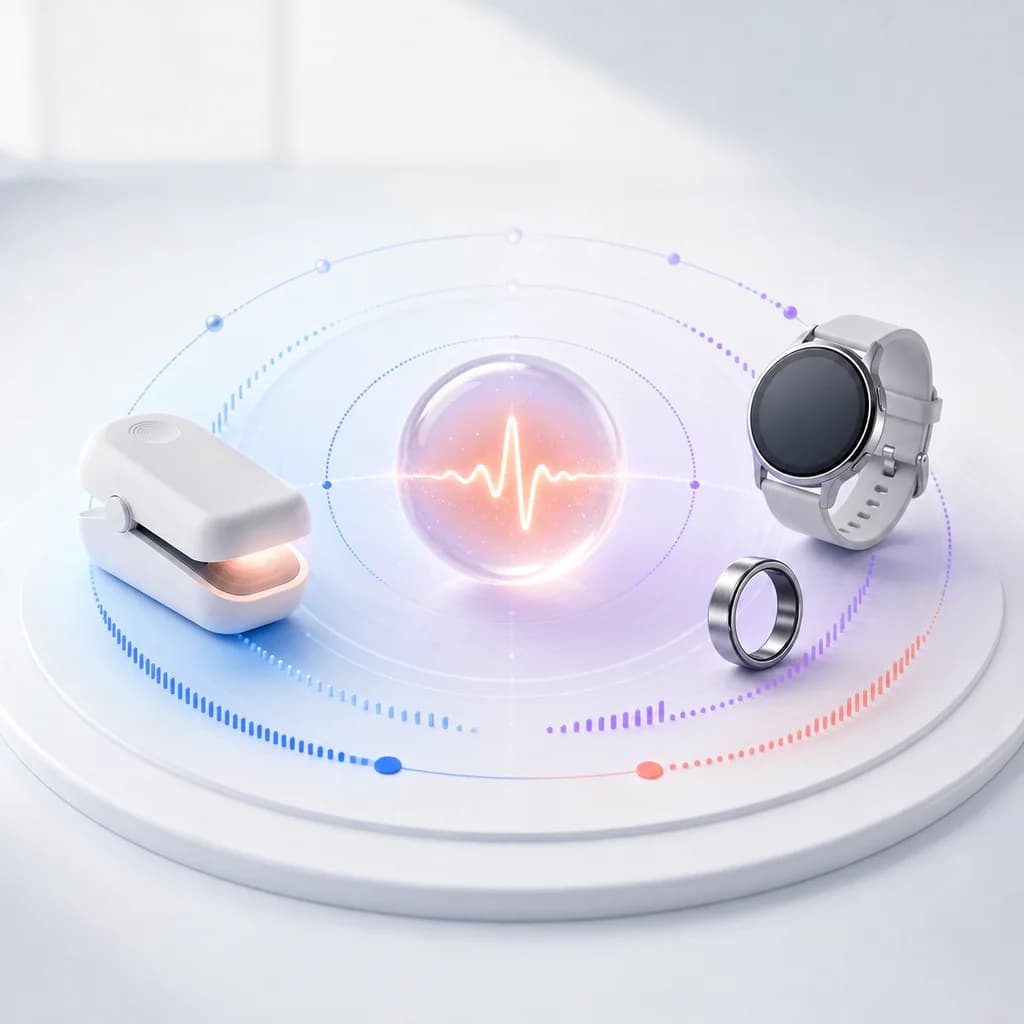
MaxPulse and most watches or rings use optical PPG and estimate pulse rate variability (PRV), even when the app uses the more familiar HRV label. ECG‑HRV comes from electrical R–R intervals and is not automatically interchangeable with PPG‑PRV. Wearables are useful for a long home trend; MaxPulse offers a short resting recording and proprietary APG processing. Neither is a diagnosis or a direct measurement of autonomic nerves or arterial stiffness.

Max Pulse vs Smartwatches and Rings: Why HRV Numbers Differ and What Each Device Actually Measures

Which Is More Accurate: Max Pulse or Smartwatches and Rings?

HRV describes variability in ECG R–R intervals. Optical devices detect the peripheral pulse wave instead and calculate PRV. Some resting time-domain metrics may agree, but pulse transit, algorithms, artefacts and measurement site can all create differences.

So “which is more accurate” does not have one simple answer. Wearables collect a long home trend, while MaxPulse takes a short resting fingertip recording and adds its own APG categories. Some consumer devices also provide vascular estimates, but their methods and values are not interchangeable with MaxPulse.

On top of that, wearables themselves aren't uniformly accurate. Independent validation studies comparing overnight HRV against clinical ECG references show that accuracy varies noticeably between brands and models. That means even two wearables can disagree with each other, let alone with an on-site measurement like Max Pulse.

How Smartwatches and Rings Calculate HRV

Photoplethysmography (PPG) is the technology behind almost every consumer watch and ring that estimates HRV. An optical sensor shines light into the skin and tracks how the reflection changes with blood pulsation – from those changes, the device derives intervals between pulses and calculates PRV, often labelled HRV.

Devices use different recording windows and metrics. Oura calculates a nightly average from five-minute samples, WHOOP uses a selected slow-wave sleep period for its daily HRV, and Apple Watch stores discrete SDNN samples. Their numbers are therefore not automatically comparable.

PPG signal quality is sensitive to a number of disruptions – movement during sleep, skin temperature, pigmentation, how snugly the band or ring fits, and ambient light. Some day-to-day variation in nighttime values may therefore be technical; some may reflect real short-term physiological changes.

How Max Pulse Processes the Pulse Wave (APG)

Accelerated photoplethysmography (APG) is mathematically the second derivative of the fingertip PPG waveform. It highlights waveform components from which MaxPulse derives proprietary vascular categories. It does not directly measure mechanical arterial elasticity or pulse-wave velocity.

MaxPulse therefore adds different processing of the same general type of optical signal, not a clinical vascular examination. Keep its APG trend within the same device rather than comparing it with differently named watch metrics.

The vascular component makes the most sense read alongside blood pressure and overall workload context, not in isolation. If APG or HRV repeatedly show unusual values, that's a cue to pay attention and potentially talk to a doctor – not a reason to self-diagnose or panic.

Why Did My Watch Show Low HRV When I Feel Fine?

Low HRV on a watch or ring despite feeling perfectly fine often has a completely ordinary explanation. Valid reasons include alcohol the night before, shorter or interrupted sleep, a hard training session the day before, an oncoming cold, or – for women – a particular phase of the menstrual cycle. All of these place a short-term load on the autonomic nervous system.

The second group of reasons concerns signal quality. A loosely worn band, a ring that shifted, or hand movement during sleep can distort PPG and affect the reported value. Fragmented sleep with frequent waking complicates data collection further.

HRV is also highly individual – it makes the most sense to compare yourself against your own history, not your number against someone else's or against a generic benchmark from the internet. One low reading alone does not show what caused it; look at the repeated trend and any symptoms.

Max Pulse vs Watch or Ring: A Practical Comparison

The table below summarizes the main differences between device types – what each measures, how often, what its accuracy profile looks like, and whether it includes a vascular component.

The table shows tools with different uses. Watches and rings collect repeated data at home and can show the longer-term direction. Max Pulse offers a short resting recording under controlled conditions and its own APG categories. Wearables also detect pulse waves, but process vascular outputs differently.

AreaWhat it measuresWhen / how oftenAccuracy / characterVascular (APG) component
Smartwatch (Garmin, Apple Watch)HRV via wrist PPGOvernight, passive (sampled or continuous by model)Varies by model, orientationalNot Max Pulse APG; some models offer other vascular estimates
Smart ring (Oura and similar)HRV via finger PPGContinuous overnightVaries by model, orientationalNot Max Pulse APG; some models offer other vascular estimates
WhoopHRV via wrist PPGHRV from a selected sleep phase; continuous PPG captureVaries by model, orientationalNot Max Pulse APG; some models offer other vascular estimates
Max PulsePPG‑PRV + pulse-wave processing (APG)Short on-site measurement, one-timeResting recording; quality depends on signal and conditionsYes

Reading Both Numbers Together, Not Against Each Other

A number from your watch and a number from Max Pulse shouldn't be converted into each other – different recording times and sites, algorithms and metrics can produce different absolute values even when both devices work correctly. It makes more sense to track each one within its own trend.

A wearable can show a longer-term home trend over weeks or months; Max Pulse can provide another resting checkpoint during a visit. Blood pressure requires a separate cuff reading. Results can be viewed alongside body composition from InBody and grip strength from InGrip, without converting distinct measures into a common score.

When Not to Interpret the Numbers Alone

Discuss a repeatedly unusual HRV trend with a clinician, especially if you have palpitations or dizziness. Seek urgent care for new severe breathlessness, chest pain or fainting regardless of what an app reports.

PRV or APG values from these devices do not establish a diagnosis. Their indicative trends need context such as timing, sleep, training and overall health. Treatment or medication decisions should not rest on a variability number alone.

FAQ

Frequently asked questions

Why did Max Pulse and my smartwatch show different HRV numbers?

Both types of device may use PPG, but they differ in measurement site and time, recording length, filtering and how the metric is calculated. A watch or ring often reports a nighttime summary; Max Pulse takes a short resting recording on site. Do not compare absolute values one-to-one; follow each system's own trend.

Are smartwatches accurate for HRV?

Roughly, yes, but accuracy varies between brands and models, and clinical ECG remains the reference standard that wearables are validated against. Independent validation studies show some brands track that reference far more closely than others – which is also why the number is best read as a trend rather than an absolutely precise value.

Is Oura or Whoop more accurate for HRV than Garmin or Apple Watch?

Available comparison studies do show accuracy differing between brands, and in some comparisons rings or certain watches come closer to a clinical reference than other models. That said, the exact ranking can shift with device generation and study methodology, so it's not a reason to switch devices based on a single comparison – consistent use and tracking your own trend matters more.

How does Max Pulse APG differ from watch vascular outputs?

APG is the second derivative of the fingertip PPG waveform. MaxPulse derives proprietary waveform and vascular categories from it; this is not a direct measurement of mechanical elasticity. Some consumer devices offer their own vascular estimates, but their methods are not interchangeable with MaxPulse.

Should I go by the HRV from my watch or from an on-site measurement like Max Pulse?

Neither is the one that matters on its own. A watch shows a long home trend from its own algorithm; MaxPulse adds a short resting PPG‑PRV recording and APG context. Do not compare absolute values one-to-one across systems.

Curious what your HRV and pulse wave are really telling you about your body?

A wearable shows a long home trend from its own algorithm. MaxPulse adds a short resting PPG‑PRV recording and proprietary APG categories. Compare trends within the same device; neither output is ECG or a direct vascular examination.